State Public Defender Act Poised to Reshape Illinois Public Defense
Lawmakers and advocates say the reforms will improve oversight, staffing, and fairness in courtroom proceedings.
On a Sunday evening at 6 p.m. two patrol officers stopped him, searched his car, and handcuffed him, telling him he needed to come to the station. A detective, they said, wanted to “talk” to him.
More than 60 hours later, in the early hours of Wednesday morning, jail guards woke him and said he needed to be processed for court. His bail hearing was scheduled for 1:30 p.m., the booking officer told him.
Only then was he allowed to make phone calls. He reached his sister and an attorney who told him that they would be at the bond hearing. Soon after, he was escorted onto a bus for the 10-minute ride to Cook County's Sixth Municipal District Courthouse in Markham, IL.
Upon arriving in the holding room, a guard asked whether he had an attorney. He said yes; his attorney was on the way. Nevertheless, the judge insisted on moving forward, calling the case around 10 a.m., according to court documents, and appointing a public defender who, based on transcripts, appeared to be used as a “warm body.”
Without the ability to present a vigorous defense, the judge took less than three minutes to grant the prosecutor’s request to deny bond.
Scenarios like this are not uncommon in Cook County courtrooms. Scheduling pressures, staffing constraints, and administrative practices—and, in this case, a judge appointing a public defender to move a case after the legal time limit for detention without charges had already elapsed—can affect defendants’ access to timely and effective legal counsel.
But Illinois has long taken a distinctive approach to fulfilling the mandate set by Gideon v. Wainwright, the landmark Supreme Court case that, on March 18, 1963, guaranteed the right to free legal counsel for defendants who cannot afford an attorney.
In many of Illinois’ 102 counties, judges have had the authority to hire and fire public defenders at will, giving them significant control over offices meant to advocate independently for indigent defendants, creating a potential conflict of interest.
The FAIR Act (Funded Advocacy and Independent Representation Act) addresses this by establishing uniform selection procedures and protections against removal of a public defender without cause, creating a more independent and standardized public defense system across the state, say its supporters upon the bill's passage in August 2025.
As Illinois prepares to implement the FAIR Act over the coming year, officials emphasize that the reforms aim to guarantee fundamental constitutional rights.
“The right to counsel for indigent defendants in criminal prosecutions is a bedrock of our justice system. Historically, Illinois has been one of just a few states that relies on a county-based indigent defense system rather than state-level oversight. More than half of Illinois counties have part-time public defenders, and the resources available to those defenders depend on local county budgets,” says the Administrative Office of the Illinois Courts.
Lawmakers who sponsored the legislation, also known as the State Public Defender Act, have described it as a historic correction to long-standing public defense disparities.
“We have a duty to reduce disparities in our system — whether those are harsher sentences or wrongful convictions — and this law is a huge step in the right direction,” said State Sen. Robert Peters when Illinois Governor J.B. Pritzker signed the bill in August.

Set to take effect in stages over the next year, the law is the first major reform to the state’s public defense system since 1949.
Supporters hope that standardized caseloads, oversight, and additional resources will give public defenders the ability to provide meaningful representation while ensuring defendants can access counsel in a timely manner. Opponents, however, argue the bill would be costly and reduce autonomy for Illinois’ 102 counties.
Key FAIR Act reforms include:
- Creation of a statewide Office of the Public Defender to coordinate resources and set uniform standards.
- Formation of a Public Defender Commission to oversee staffing, training, and compliance.
- Establishment of caseload limits to ensure defenders have sufficient time to represent clients effectively.
- Collection and publication of data on public defense to identify gaps and inequities across counties.
- Provision of additional funding and support to under-resourced offices statewide.
While the FAIR Act doesn’t directly discipline judges, supporters say that it limits opportunities for procedural shortcuts, makes misuse visible, and establishes systemic checks to protect defendants’ right to meaningful legal representation.
Uniform caseload limits and timelines may reduce the ability of judges to rush cases or appoint a public defender solely to move the docket along. Judges would need to follow standardized procedures that ensure defendants have access to their chosen attorney or are assigned counsel in a timely, regulated manner.
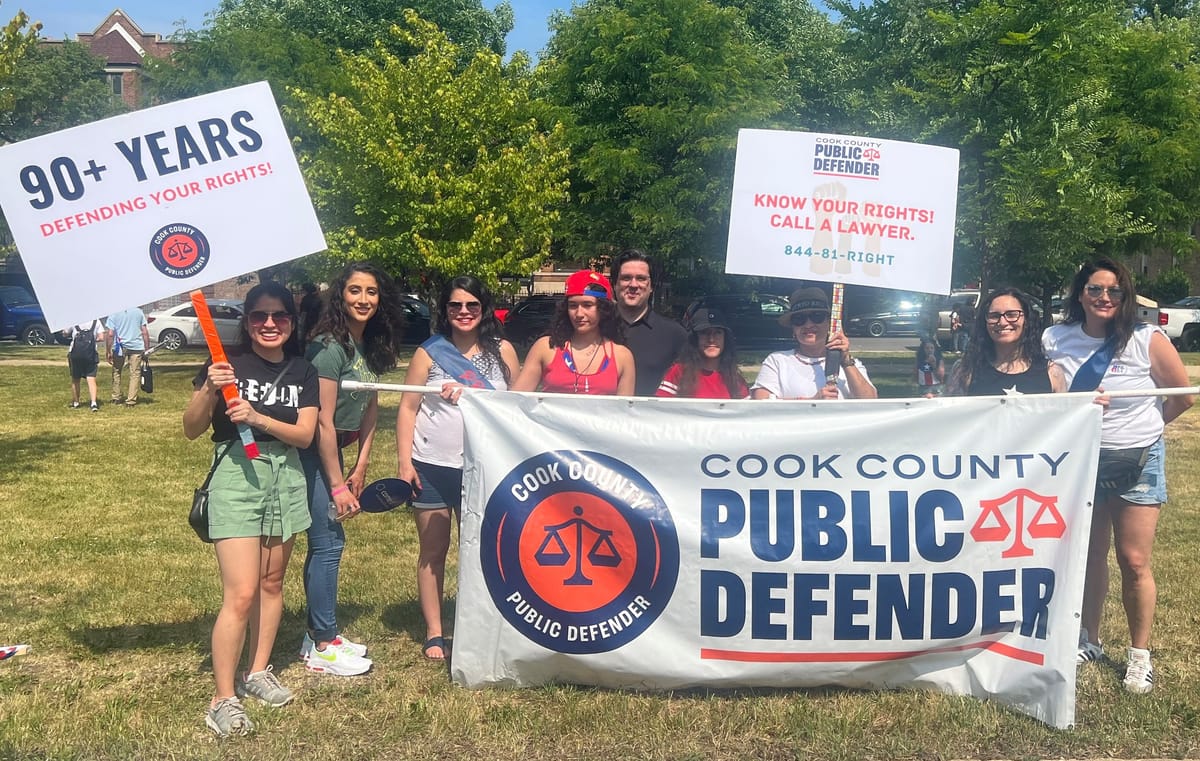
The law also targets long-standing challenges in Cook County, home to one of the largest public defender offices in the country.
In 2023, the Cook County Public Defender’s Office handled roughly 14,800 felony and 32,400 misdemeanor appointments.
With reported staffing shortages and no systematic workload tracking, attorneys say that they often juggle back-to-back clients with limited time to review evidence, according to a 2021 report by the Sixth Amendment Center.
These challenges illustrate why advocates and lawmakers argue that FAIR Act provisions like caseload limits and additional resources are essential to ensure defendants receive meaningful access to counsel.
“The right to an attorney is not just the right to a warm body in court, but the right to a meaningful defense,” said Stephanie Kollmann, policy director at Northwestern University’s Children and Family Justice Center.
FAIR Act Timeline:
- July 1, 2026: State Public Defender Commission becomes effective; appointments expected by October 1, 2026.
- January 1, 2027: Office of the State Public Defender begins operations.