From First-Degree Murder to Probation: Two Tales of Keshia Golden’s Prosecution
What happens when the initial charge and the resolution tell radically different stories about the same conduct?
For nearly four years, Cook County prosecutors maintained that Keshia Golden committed first-degree murder when she fatally stabbed her boyfriend, Calvin Sidney.
On Monday, they were finally scheduled to prove it.
Instead, prosecutors offered Golden a deal: If she pleaded guilty to involuntary manslaughter and agreed to two years of probation, she would not spend time in prison.
The dramatic difference between the initial charge and the outcome raises a question: How did a first-degree murder prosecution end with involuntary manslaughter and probation?
Golden's attorneys say the answer is simple.
"Keshia Golden is innocent. She is not guilty of these charges," Julie Koehler, associate director of the Homicide Task Force at the Cook County Office of the Public Defender, said at a March 24 press conference.
"The offer from the State's Attorney's office clearly shows that prosecutors never believed they could convince a judge or jury that our client, Keshia Golden, was guilty of first-degree murder."
But the State continues to stand behind its account of the stabbing.
"Today's resolution reflects our commitment to making fair evidence-based decisions that consider the full circumstances of each case and serve the interests of justice," the State's Attorney's Office said.
A first-degree murder case
In a statement provided to the Cook County Courtroom Observer Tuesday, the State's Attorney's Office said that, according to information shared in open court Monday, Golden approached Sidney with a knife while he was unarmed and lying on a bed in a separate room. A witness tried to stop her, prosecutors said, but Golden reached around the witness and stabbed Sidney.
That account appears to be consistent with the version prosecutors presented earlier in the case. Prosecutors said Golden and Sidney had been arguing about who could use the microwave to reheat food when Sidney grabbed Golden and pushed her onto a counter. According to the prosecution's account, relatives separated them and Sidney went into a bedroom. Golden then retrieved a knife and followed him into the room.
Witnesses at the home identified Golden to police as the person who stabbed Sidney. Prosecutors said Golden returned to the home as officers arrived and admitted stabbing Sidney.
Prosecutors approved first-degree murder charges against Golden in October 2022.
Under Illinois law, first-degree murder generally requires prosecutors to prove that a person killed another without lawful justification and either intended to kill or cause great bodily harm, knew the acts would cause death, or knew they created a strong probability of death or great bodily harm.
That distinction is important in Golden's case. Involuntary manslaughter — the offense to which prosecutors ultimately agreed Golden could plead guilty — applies when a person unintentionally causes a death through reckless acts likely to cause death or great bodily harm.
Golden's attorneys describe the stabbing as an act of self-defense.
They say Sidney attacked Golden, slamming her against a kitchen counter and refrigerator. A relative attempted to separate them, according to the defense, but Sidney continued the attack. Golden grabbed a knife and stabbed him in the leg to protect herself and her unborn child.
Golden's attorneys have pointed to a documented history of domestic violence between the couple that they say supports her claim of self-defense.
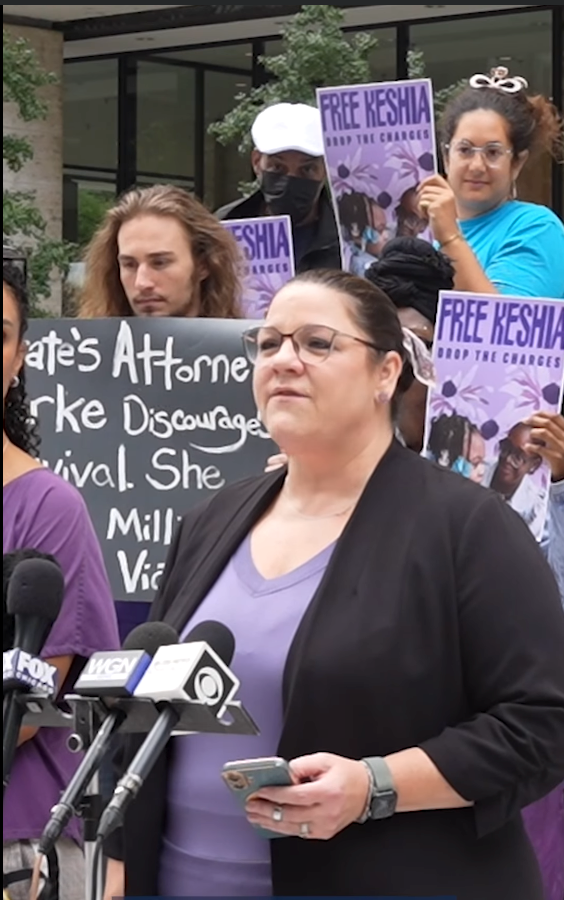 "This is a case that never should have gone to trial," Assistant Public Defender Kyan Keenan said days before Golden's bench trial before Cook County Circuit Court Judge Steven Watkins was set to begin. "We believe that the medical evidence, the physical evidence and the extensive history of violence speak louder than any accusation."
The Public Defender's Office says Golden called Chicago police more than 50 times to report abuse during her relationship with Sidney. Records reviewed by the Chicago Sun-Times show police responded to five domestic-violence incidents involving Golden and Sidney between June and September 2022. In four of those incidents, Golden reported that Sidney had choked, punched, slapped or pushed her.
Police records also document an allegation of violence going in the other direction. In one incident, prosecutors said Sidney accused Golden of stabbing him in the neck. He was hospitalized but did not pursue charges.
In July 2022, Golden obtained an order of protection against Sidney after reporting that he punched her in the face, according to court records and police reports.
"The court will hear how Keshia endured months of escalating violence in the months leading up to the birth of her daughter," Keenan said.
"Dismiss these charges and let Keshia and her daughter walk free into their futures."
Amid calls from Golden's attorneys and supporters to dismiss the case, the State's Attorney's Office continued to defend its charging decisions.
"In this case, and in every case that we handle, we carefully evaluate the facts and the law to make appropriate charging decisions and to seek justice on behalf of victims," the office said. "These determinations are based on a thorough review of the evidence that is gathered by law enforcement and presented to us at the conclusion of their investigation."
At Golden's initial bond hearing in October 2022, a judge set bail at $2 million.
Shortly afterward, however, prosecutors changed their position on whether Golden needed to remain jailed.
At a November 2022 hearing, Assistant State's Attorney Anne McCord Rodgers told the court that, after reviewing the case, prosecutors supported releasing Golden on her own recognizance. But Rodgers said the office had no intention of dropping or reducing the murder charge.
Cook County Circuit Court Judge Mary C. Marubio instead imposed a $50,000 bond. A community bond fund provided the $5,000 necessary for Golden's release.
Golden gave birth to her daughter while the murder case remained pending.
Then came a different offer
By 2026, Golden's attorneys and domestic violence advocates were publicly calling on Cook County State's Attorney Eileen O'Neill Burke to dismiss the prosecution.
The State refused.
But in March, prosecutors offered Golden something significantly different from the charge they had pursued for more than three years.
She could plead guilty to second-degree murder and receive two years of probation, with no additional time in custody.
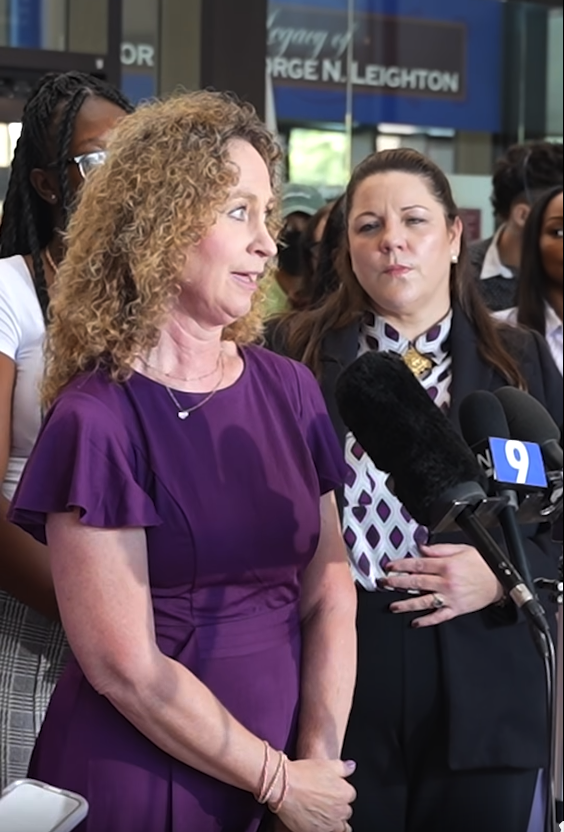 Her lawyers continued to argue that Golden shouldn't have to plead guilty because she acted in self-defense. They also said a second-degree murder conviction would create lasting consequences for Golden, including barriers to employment and housing.
"They think that we should be grateful that they have given us an offer of probation," Koehler said in a March 2026 podcast. "That conviction will follow her for the rest of her life. That is no gift. They need to do the right thing and they need to drop these charges."
Golden turned the offer down. The case moved toward trial. Then came Monday.
Golden was scheduled to stand trial before Judge Steven Watkins on the first-degree murder charge.
Instead, prosecutors made another offer.
This time, the State allowed Golden to plead guilty to involuntary manslaughter, a Class 3 felony, and receive two years of probation. She must also perform 30 hours of community service and undergo drug testing.
Unlike the earlier second-degree murder offer, the involuntary manslaughter conviction will not require Golden to register as a violent offender.
She took the deal.
A prosecutor's job is different
The progression from first-degree murder to second-degree murder and finally involuntary manslaughter isn't simply a difference in punishment.
The offenses reflect substantially different assessments of culpability.
And that makes the role of the prosecutor important.
Illinois' ethical rules impose special responsibilities on prosecutors.
"The duty of a public prosecutor is to seek justice, not merely to convict," states Rule 3.8 of the Illinois Rules of Professional Conduct. The commentary accompanying the rule describes prosecutors as "minister[s] of justice."
CCSAO uses similar language in defending its resolution of Golden's case. The office said the plea "serve[s] the interests of justice." The State continues to cite the facts underlying its case against Golden.
Those positions are not necessarily incompatible. Prosecutors can agree to resolve a case with a lesser offense even when they believe a more serious charge is supported.
The unresolved question is how first-degree murder remained the State's charge for nearly four years before prosecutors concluded that involuntary manslaughter and probation also served the interests of justice.
Why Golden took the plea
For Golden, the State's decision ultimately presented a deeply personal choice.
A guilty plea records what a defendant admitted in court. It doesn't necessarily establish why a defendant decided that pleading guilty was preferable to going to trial — or resolve every question about factual innocence.
The Illinois Supreme Court recognized that distinction in a 2020 decision involving a defendant who pleaded guilty and later asserted his innocence. In People v. Reed the court held that a guilty plea does not prevent a defendant from later bringing an actual-innocence claim.
The court acknowledged a reality at the heart of plea bargaining: A defendant's decision to plead guilty can be based on considerations that have nothing to do with guilt. "Pleas are no more foolproof than trials," the court wrote.
Golden had rejected the State's March offer.
But on Monday, the calculation was different.
She could proceed with a trial on first-degree murder, knowing that a conviction could separate her from her daughter for decades.
Or she could accept a felony conviction for involuntary manslaughter and remain home with her.
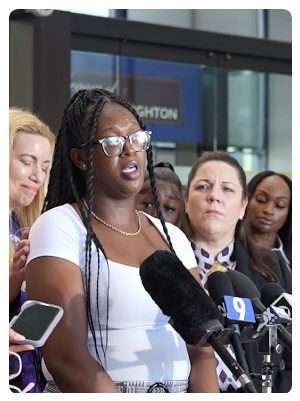
"I do not want to hurt my child no more then what she already hurting — all she got is me," Golden said, according to CBS Chicago. "My child will not have a father, and I'm the only person that's going to take care of her, so I feel like I did the right thing for my child."
The Public Defender's Office argues that Golden's decision illustrates the leverage defendants face when choosing between the risk of a far more severe sentence at trial and accepting a conviction.
"Our clients face these difficult and personal decisions every day when choosing between the risk to their freedom at trial and pleading guilty to something they are innocent of," the office said following Golden's plea.
Koehler was more pointed about the decision Golden faced Monday.
"There isn't a woman or a mother alive that, when faced with spending 20 to 60 years in prison, wouldn't take a plea deal to probation," Koehler said.
For Golden, the calculation was simpler.
"The main thing is I'll be raising my daughter," she said.