How can prosecutors continue pursuing a case after a court throws out a conviction?
This morning, the Chicago Sun-Times published an investigation into Ivy Kelly's decades-long fight to clear his name.
According to prosecutors, Kelly and a co-defendant fatally shot Joseph Ward on Dec. 10, 1999. At Kelly's 2003 bench trial, the State's case relied in significant part on the pretrial statements of two witnesses, Christopher Lacy and Paula Scott, both of whom later recanted their identifications at trial. Even so, the trial court found Kelly guilty of first-degree murder.
In 2014, the Illinois Appellate Court revived Kelly's post-conviction case after concluding that he had made a substantial showing that his trial attorney failed to adequately investigate and challenge Lacy's credibility. That issue was especially important because Scott testified at trial that she had identified Kelly as one of the shooters only after Lacy told her that Kelly and his co-defendant were responsible.
The court held that Kelly had made a substantial showing of constitutional violations warranting an evidentiary hearing.
Kelly was given a choice: plead guilty and go home, or reject the deal and continue fighting to clear his name. He chose to keep fighting. Now more than a decade later, Kelly remains in custody as prosecutors prepare to try him again.
Chip Mitchell's reporting, accompanied by powerful images of Kelly working inside the Cook County Jail as he awaits trial this fall, focuses on the human cost of his choice to keep fighting. During those years, Kelly's five children grew up without him. And he lost his mother.
As I read Mitchell's story, I found myself also drawn to the legal question behind Kelly's fight.
How can prosecutors continue pursuing a case after a court throws out the conviction?
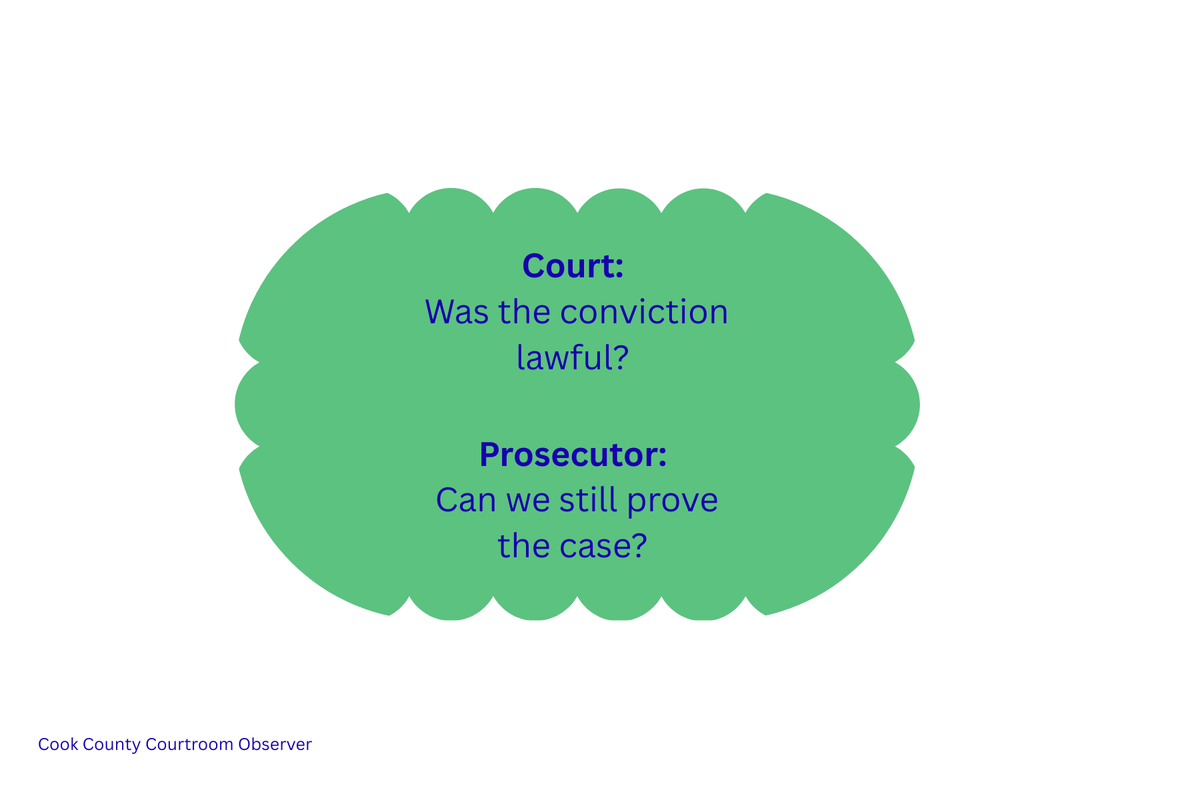
The answer lies in the different roles our justice system assigns to judges and prosecutors.
Courts decide whether a conviction was obtained in accordance with the law and the Constitution. Prosecutors decide whether they believe sufficient admissible evidence remains to prove the charges beyond a reasonable doubt.
Those are different questions, and they don't always produce the same answer.
A judge's decision to vacate a conviction isn't the same as declaring a defendant innocent. It means the court has determined that the conviction can't stand because of a legal or constitutional problem with the trial. That could involve newly discovered evidence, ineffective assistance of counsel, improper jury instructions, prosecutorial misconduct, or another error significant enough to undermine confidence in the verdict.
When that happens, the conviction is no longer legally valid. But in many cases, the criminal charges themselves remain pending.
So the court answered one question: whether Kelly's conviction could legally stand. It didn't answer the next one: whether prosecutors should continue trying to prove the case.
Apparently concluding that they still have sufficient evidence to seek another conviction, prosecutors have continued pursuing the murder case against Kelly. That decision has left Kelly in custody awaiting a new trial.
At this point, you may be wondering: What about double jeopardy?
It's a fair question.
The Constitution generally prohibits the government from trying someone twice for the same alleged offense. But when a conviction is thrown out because of a legal or constitutional error, courts usually allow prosecutors to seek a new trial. That's because the court has determined that the original trial was flawed, not that the prosecution failed to prove its case.
Now, if an appellate court concludes that the evidence was legally insufficient to support a guilty verdict, the outcome is different. In that situation, prosecutors generally don't get another chance to try the case.
Once a conviction has been vacated, prosecutors generally have several options. They can dismiss the charges. They can attempt to negotiate a plea agreement. Or they can decide to retry the case before a new jury.
The question for them then becomes: Can we still prove this case beyond a reasonable doubt today?
Evidence that once seemed compelling may have weakened over time. Witnesses may have died or become difficult to locate. New forensic testing may change the picture.
Prosecutors may conclude that, despite errors in the original trial, enough admissible evidence remains to seek another conviction.
If Kelly is retried, prosecutors will again attempt to prove their theory of what happened during the December 10, 1999 shooting, even though two key witnesses whose pretrial statements implicated Kelly later recanted those statements at trial.
But that raises another set of questions.
How does the Cook County State's Attorney's Office decide whether to retry a case after a conviction has been vacated? What standards guide those decisions? Are there written policies? How often does the office choose to retry a case, and how often are charges dismissed instead?
Those questions sent me down a reporting path this morning. In the coming weeks, I'll be looking for answers. I'm curious whether written policies guide when a vacated conviction should be retried and when charges should be dismissed.
If there's one takeaway from Kelly's case, it's this: A court's decision to throw out a conviction doesn't necessarily end a criminal case. Sometimes, it marks the beginning of a new chapter—one that raises difficult questions not only about guilt or innocence, but also about who decides when another trial is in the interests of justice.