He complied with a no-contact order. Weeks later, he was arrested for an alleged parole violation.
As we approach the Fourth of July holiday, I've been following a case that has only deepened my unease about how easily justice and freedom can be derailed in Cook County.
At the beginning of June, someone at the center of one of the cases I've been following was arrested for an alleged parole violation.
Just weeks earlier, he had been released from pretrial detention after reaching an agreement with the Cook County State's Attorney's Office that ended four years of prosecution and pretrial detention. Prosecutors dropped the underlying allegation in exchange for a "time-served" disposition, meaning the four years he had already spent in custody as they built their case were deemed sufficient for a reduced charge.
But even then, I was troubled by what that resolution represented. Over months of reporting, I found little evidence supporting the underlying allegation and substantial information that provided a counter narrative – the accused person was actually the victim.
Yet he still had to accept a conviction to regain his freedom.
Four years of pretrial detention had become leverage. Faced with the choice between continuing to fight the charges from jail or going home, he accepted a plea that allowed him to move forward with his life.
It is one of the stark realities of the criminal justice system: prolonged pretrial detention can pressure people to resolve cases even when the evidence remains weak, circumstantial and contested.
The resolution came with conditions. He was required to stay away from the person who made the complaint and serve six months of Mandatory Supervised Release, commonly known in Illinois as parole.
For him, it was a day of relief. After four years in custody, he was finally returning to the community. Ironically, the no-contact order also protected him. It established a legal boundary that, from his perspective as well as his friends and family, allowed him to begin rebuilding his life.
And now that fragile freedom has collapsed again.
One condition of his parole was no social media contact with the complainant. After roughly three weeks back in the community, his attorneys returned the phone he had used before his detention. It still contained his Facebook credentials. After helping him regain access to his Facebook account, his family helped him block the complainant and members of her family from his account.
On Facebook, blocking is a two-way mechanism: when one person blocks another, both are cut off from interaction and visibility, creating a mutual boundary rather than a one-sided act. And so, the complainant could no longer see his profile.
Two weeks later, more than a dozen agents from the Cook County Sheriff’s Police Fugitive Apprehension Unit and the U.S. Marshals Great Lakes Regional Fugitive Task Force descended on his parole host site to arrest him.
Due to the presence of federal agents at the arrest, the executive director of his MSR host site told me he was concerned about the possibility of federal charges. But there were none.
According to records I obtained through the Illinois Freedom of Information Act, the complainant reported seeing him "on her Facebook page as a non-follower" and showed a patrol officer a picture of his Facebook account.
She made the complaint within 30 minutes of him blocking her account.
In a later conversation with his parole officer, the allegation expanded. She said he had "accessed her Facebook page [and] was viewing her pictures." She also claimed to have "screenshot proof" that he had visited her content.
After learning about the allegation, the very first thing I did was search a simple question: Does Facebook provide users with a record of who views their profile?
The answer, based on Meta's publicly available guidance, is no. Meta does not provide users with a list of who has viewed their Facebook profile.
So I presented this information to a legal official at the Illinois Prisoner Review Board, the agency responsible for reviewing parole violations. The response surprised me. I was told that if the preliminary hearing officer did not understand how Facebook works, there were three other officials who would review the case and perhaps one of them would raise the concern.
Then I reviewed the investigative records I obtained through FOIA. The parole agent appears to have relied on the complainant's account of what had occurred and her statement that she possessed "screenshot proof." The records I reviewed do not show that any screenshot or platform data was independently reviewed or preserved.
That raises a basic question: How is a social media-based allegation verified when the platform itself does not provide the information the allegation depends upon, and when no independent digital evidence is secured?
As of my current reporting, I have not found any publicly available guidance explaining how Illinois officials evaluate alleged social media violations of no-contact orders.
Facebook does, however, allow users to review activity associated with their own account.
With the accused person's permission, I reviewed his Facebook account activity. I found no visits, views, comments, likes, shares, messages, or other visible interactions between the accounts during the relevant period.
Still, the process has no obvious offramp. A hearing officer who acknowledged that he had not "touched Facebook for 20 years" conducted a preliminary hearing as though the allegation had already been verified and found probable cause to continue the revocation proceedings.
The accused person now remains detained pending a final revocation hearing before the Illinois Prisoner Review Board.
He will spend a fifth Independence Day behind bars.
Illinois has recently invested in reforming the Prisoner Review Board. Following the 2024 murder of 11-year-old Jayden Perkins by a man who had been released shortly before the attack, Governor JB Pritzker created the Board's first executive director position to strengthen administration and expand domestic violence prevention training.
Those reforms were intended to improve how the Board handles cases that allege domestic violence.
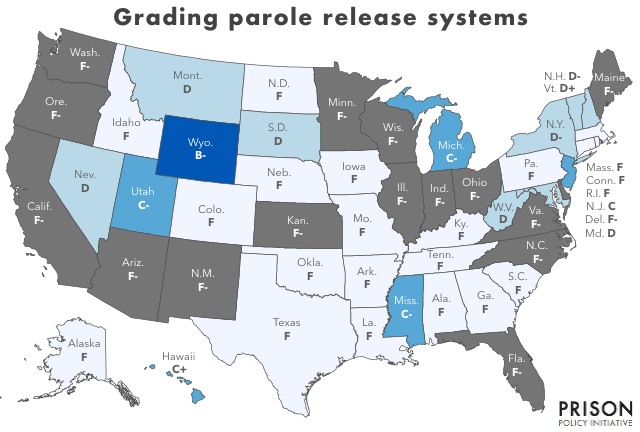
The Prison Policy Initiative has given Illinois parole systems an “F-,” citing weak procedural protections, opaque decision-making, and uneven access to case materials—conditions that leave broad discretionary authority with limited structure for how decisions are made or reviewed. Although the report focuses on parole release systems, its critique raises broader questions about how post-release supervision functions once a violation is alleged.
In Illinois Mandatory Supervised Release operates differently from discretionary parole, but it similarly involves decisions about liberty being made in administrative settings with limited evidentiary testing
But as my reporting continued, I found myself asking a different question: What guidance exists when a parole violation alleges unverified social media evidence? As of my current reporting, I have not found publicly available standards explaining how those allegations should be evaluated before a person's liberty is taken away.
What makes this case difficult to reconcile is not simply what was alleged, but how quickly the allegation became actionable.
In most U.S. jurisdictions, parole and probation revocation proceedings require only minimum due process under Morrissey v. Brewer (1972) and Gagnon v. Scarpelli (1973), meaning they do not carry the evidentiary safeguards of a criminal trial. In practice, decisions are often driven by complainant reports and parole officer assessments of credibility and risk rather than independently tested evidence.
In this case, based on the records I reviewed, there is no indication that the alleged digital evidence was independently verified before the arrest, and no documented forensic review of Facebook activity appears in the file.
Instead, the allegation itself appears to have become the operative fact triggering detention. Within weeks of returning home after four years in custody, he was taken back into custody without clear evidence presented at the time or preserved in the record.
As the country prepares to celebrate 250 years of liberty, I can’t help wondering how secure that promise really is when a person’s freedom can hinge on an allegation about activity a social media platform itself says it does not track.